Can a 3D-printed vase hold water?
The short answer
Not reliably, and we would not recommend it. A standard 3D-printed PLA vase is not waterproof: water finds the microscopic gaps between layer lines and seeps through or weeps at the base, usually within a few days. The fix is a liner — drop a glass tube, test tube or small jar inside the vase and let the print be the sleeve.
This is the question we are asked most often, and the honest answer is more useful than the flattering one. A vase printed in plant-based PLA on a standard printer is water-resistant at best. It is not a sealed vessel, and treating it like one is the quickest way to ruin both the vase and the surface it is standing on.
Why layer lines leak
Fused-filament printing builds an object by laying down molten plastic in stacked lines. Each line bonds to the one beneath it, but the bond is mechanical rather than a true fusion, and where three lines meet there is a small triangular void. Multiply that by a few thousand layers and you have a wall that looks solid and behaves like a very fine sieve.
Water does not need much. Given a day or two of standing pressure it works into those voids, travels sideways along a layer, and appears on the outside of the vase as a damp patch or a ring on the shelf. Nothing dramatic happens — there is no burst — but the vase sweats.
A second, slower problem sits behind the first. PLA is a polyester made from plant sugars, and polyesters hydrolyse: prolonged contact with water gradually breaks the polymer chains. On a decorative timescale this is very slow, but it is another reason we do not design our vessels around holding water.
What we recommend instead
Use the print as a sleeve and put the water in glass. This is not a compromise so much as how most ceramic-look vases in shops already work, and it solves every problem at once: the water is contained, the vase stays dry, and you can lift the liner out to clean it.
- Find a glass that fits — a test tube, a narrow jam jar, a cut-down water bottle or a florist's glass tube.
- Drop it inside the print so the rim sits just below the vase rim.
- Fill the liner, not the vase, and arrange stems into the liner.
- Lift the liner out to change the water so nothing spills into the print.
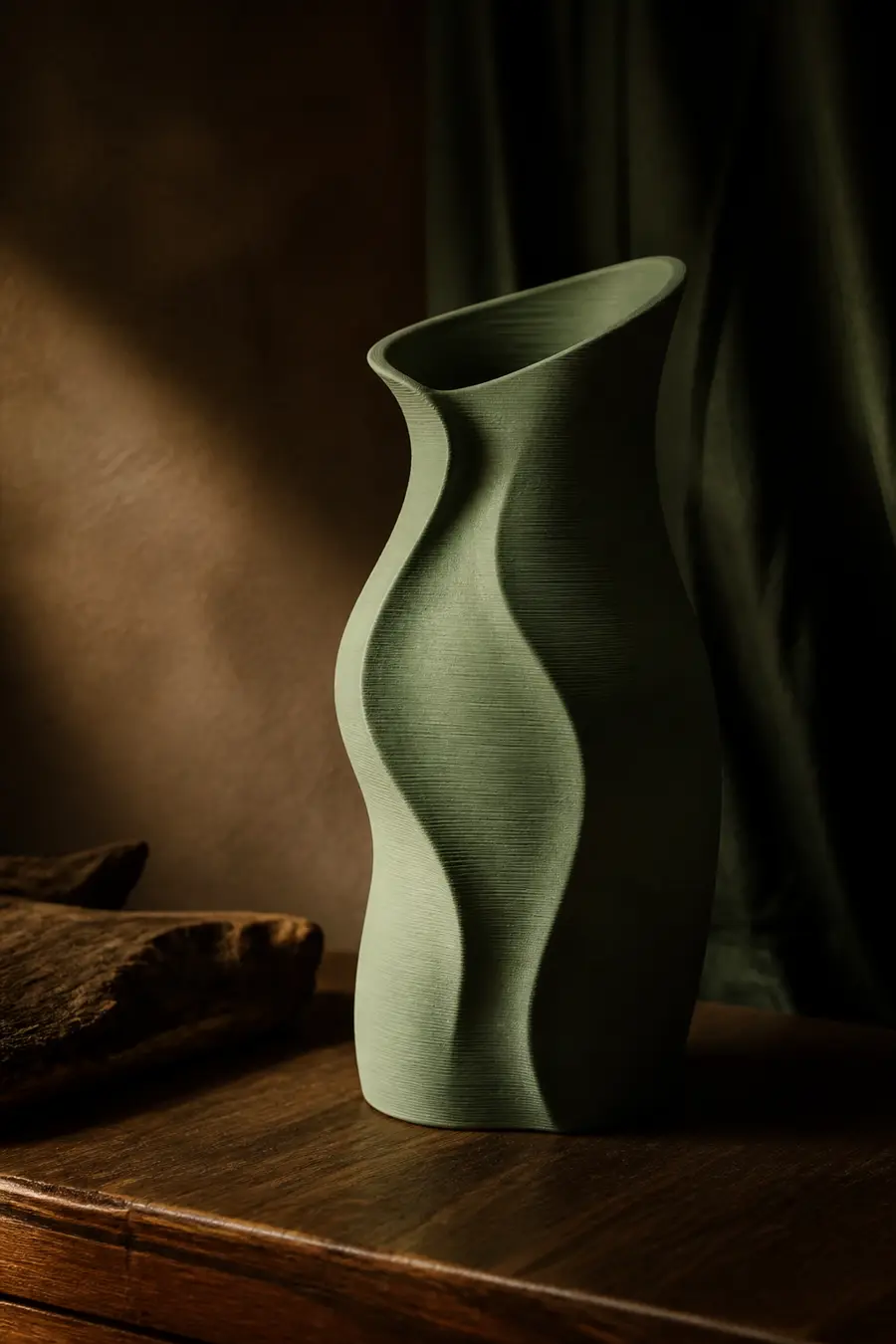
The alternative is to skip water entirely. Dried stems, grasses, branches, bunny tails and preserved eucalyptus all sit directly in the print and last for years, which is the use our Wave Vase was actually drawn for.
What about sealing the inside?
It is possible to seal a PLA print — epoxy resin, food-safe varnish and specialist coatings all work to a degree — and plenty of people online do it. We do not do it here, for two reasons.
The first is honesty about the result. A hand-applied internal coating on a tall narrow vessel is very hard to inspect. We cannot look inside a finished vase and promise you the seal is unbroken, so we would be selling a guarantee we could not check.
The second is that it works against the material choice. The reason we print in plant-based PLA rather than a petroleum resin is that PLA is the least loaded option available to a small studio. Lining the inside with epoxy to make it waterproof puts the petroleum back in, in the one part of the object you can never remove it from.
How long will a printed vase last?
Kept dry, indefinitely. PLA is dimensionally stable at room temperature and does not yellow noticeably indoors over normal timescales. The two things that shorten a print's life are heat and sustained ultraviolet light.
| Condition | What happens | What to do |
|---|---|---|
| Room temperature, indoors | No meaningful change | Nothing — dust it occasionally |
| Sustained heat above ~55°C | PLA softens and can slowly deform under its own weight | Keep it out of closed cars and off radiators or heat vents |
| Direct afternoon sun, over years | Gradual embrittlement and slight colour shift | Prefer indirect light; rotate the piece occasionally |
| Standing water inside | Seepage through layer lines; very slow hydrolysis | Use a glass liner |